

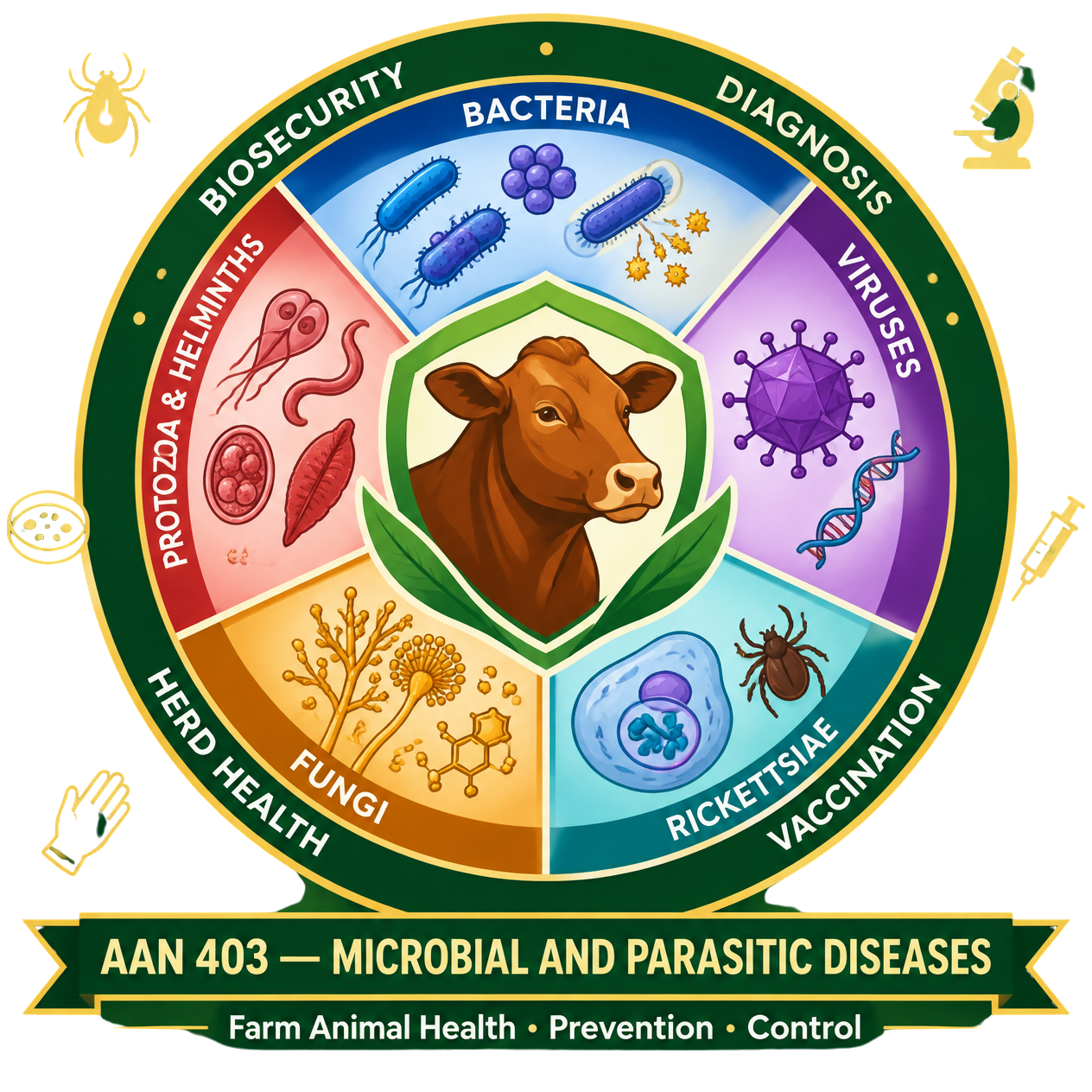
Course Overview: AAN 403 - Microbial and Parasitic Diseases
Course Lecturer: Dr. Benard Odhiambo
1. Course Description
AAN 403 is an advanced undergraduate course that provides a comprehensive study of the microbial and parasitic diseases of farm animals. The course integrates principles of microbiology, parasitology, epidemiology, pathology, and herd health management to equip students with the knowledge and practical skills needed to recognize, diagnose, prevent, and control economically important diseases affecting livestock production.
The course covers diseases caused by bacteria, viruses, rickettsiae, fungi, protozoa, and helminths, with particular attention to the East African context - its climate, production systems (pastoralism, mixed farming, intensive units), and the associated disease challenges that constrain livestock productivity.
2. Course Rationale / Justification
- Livestock is a cornerstone of East African economies - supporting livelihoods through milk, meat, draught power, and cultural value.
- Disease remains a primary constraint to productivity - causing mortality, reduced growth, production losses, trade restrictions, and poor welfare.
- The region's climate (arid to tropical), management practices (pastoralism, transhumance), and limited veterinary infrastructure create a unique disease landscape.
- There is a critical need for graduates who understand both the pathogens and the management systems required to control them - moving beyond treatment of individual sick animals toward prevention, surveillance, and continuous improvement of herd health.
3. Course Aim
To develop in students a holistic, integrated understanding of farm animal diseases - their causes, mechanisms, transmission, diagnosis, economic and welfare impacts, and control - with emphasis on prevention-oriented herd health management appropriate to East African livestock production systems.
4. Learning Outcomes
By the end of this course, students should be able to:
- Define and classify farm animal diseases - clinical vs. sub-clinical, infectious vs. non-infectious, endemic vs. transboundary.
- Explain the key terminology of disease (pathogen, commensal, virulence factors, zoonosis, morbidity, mortality, case fatality rate, carrier states).
- Apply the Disease Triangle / Epidemiological Triad to analyze factors that enhance disease spread.
- Identify the principal reasons for disease spread - animal movement and trade, biosecurity failures, environmental factors, vectors, host-related factors, pathogen characteristics, and human/management factors.
- Describe the major categories of pathogens (bacteria, viruses, rickettsiae, fungi, protozoa, helminths) - their structures, virulence factors, mechanisms of damage, and classification.
- Recognize the important bacterial, viral, rickettsial, fungal, protozoal, and helminth diseases of farm animals - their etiology, epidemiology, pathogenesis, clinical signs, diagnosis, treatment, and control.
- Explain nutritional deficiency diseases - mineral, vitamin, energy, and protein deficiencies - their pathogenesis, clinical signs, and prevention.
- Describe the key properties of important causal organisms and how structure–function relationships determine virulence.
- Select appropriate laboratory diagnostic techniques for digestive tract parasites and other pathogens - including sample collection, qualitative and quantitative methods, and specialized techniques.
- Design integrated disease control and prevention programs - combining biosecurity, biocontainment, vaccination, parasite control, nutrition, stress management, and veterinary partnership.
- Discuss the economic and welfare impacts of farm animal diseases - including the Five Freedoms framework.
- Explain the specific disease challenges of East Africa and the control strategies adapted to local conditions.
5. Course Content / Topics
Part I: Foundations of Farm Animal Disease
- Introduction to Farm Animal Diseases - definition and core concepts; clinical vs. sub-clinical disease; infectious vs. non-infectious; key terminology; Disease Triangle and Epidemiological Triad; modes of transmission; major pathogen categories; economic and welfare impacts; principles of disease control.
- Reasons for Spread and Management of Farm Animal Diseases - the Disease Triangle as a framework; principal reasons for spread (animal movement and trade, biosecurity failures, environmental factors, vectors, host-related factors, pathogen-related factors, human/management factors); the convergence of factors (cascade of failures); management and control (biosecurity, vaccination, diagnostics, movement management, environmental management, vector control, host resilience, human factors).
- Farm Animal Diseases Caused by Nutritional Defects - primary vs. secondary deficiencies; mineral deficiencies (Ca, P, Mg, Se, Co, Cu); vitamin deficiencies (A, D, B complex); energy and protein deficiencies; diagnosis and control.
- Important Properties of Causal Organisms of Farm Animal Diseases - Bacillus anthracis, Clostridium chauvoei, Mycobacterium bovis, Escherichia coli (ETEC), Brucella abortus, Mannheimia haemolytica; structure of a pathogenic bacterium and its virulence factors; FMDV, BVDV, ASFV; structure of viruses and their virulence factors; Anaplasma marginale, Ehrlichia ruminantium, Coxiella burnetii; structure of rickettsiae and their virulence factors; Trichophyton verrucosum, Aspergillus fumigatus, Candida albicans; structure of fungi and their virulence factors.
Part II: Major Pathogen Groups and Diseases
- Bacterial Diseases of Farm Animals - bacterial pathogenesis; mechanisms of damage; classification; systemic and septicemic diseases (Anthrax, Blackleg, Haemorrhagic Septicaemia); respiratory diseases (BRD complex, CBPP); gastrointestinal diseases (Colibacillosis, Salmonellosis, Johne's disease); reproductive diseases (Brucellosis, Leptospirosis); mammary and foot diseases (Mastitis, Foot Rot); general principles of diagnosis, treatment, and control.
- Viral Diseases of Farm Animals - viral pathogenesis; mechanisms of damage; classification; systemic and highly contagious OIE-listed diseases (FMD, CSF, ASF, Avian Influenza); respiratory diseases (IBR, BRSV, PI3, PRRS); gastrointestinal diseases (Rotavirus, Coronavirus, TGE, BVD); reproductive diseases (PPV); neurological diseases (Rabies, Pseudorabies); general principles of diagnosis, treatment, and control.
- Diseases Caused by Rickettsiae - introduction and taxonomy (Rickettsiales vs. Chlamydiales); obligate intracellular parasitism; vectored transmission; target cells; pathogenesis (vasculitis, cytopenia); major diseases (Bovine Anaplasmosis, Heartwater, Q Fever, Ehrlichiosis, Eperythrozoonosis); general principles of diagnosis, treatment, and control.
- Diseases Caused by Fungi - fungal pathogenesis; opportunism; environmental reservoirs; classification of mycoses (superficial, subcutaneous, systemic); major diseases (Dermatophytosis/Ringworm, Aspergillosis, Mycotic Rumenitis and Mastitis, Mucormycosis/Zygomycosis); mycotoxicoses (Aflatoxicosis, Ochratoxicosis, Ergotism, Fusariotoxicoses); general principles of diagnosis, treatment, and control.
- Diseases Caused by Protozoans - introduction to protozoan parasites; major groups (Apicomplexa, Sarcomastigophora, Ciliophora); digestive diseases (Coccidiosis, Cryptosporidiosis); blood-borne and systemic diseases (Babesiosis, Theileriosis, Trypanosomiasis); reproductive and neurological diseases (Neosporosis, Toxoplasmosis, Sarcocystosis); summary table of key protozoal diseases.
- Laboratory Diagnosis of Digestive Tract Parasites - diagnostic pathway; sample collection and handling; preservation; gross examination; qualitative methods (direct saline smear, fecal flotation, fecal sedimentation); quantitative methods (McMaster technique, FECRT); coproculture and larval identification; specialized techniques (Coccidia, Cryptosporidium, Giardia); post-mortem examination (gold standard); diagnostic technique selection guide.
Part III: Applied Disease Control
- Common Microbial and Parasitic Diseases of Economic Importance - detailed study of FMD, Anthrax, East Coast Fever, CBPP, PPR, Haemonchosis (Barber's Pole Worm), Trypanosomiasis (Nagana), and Avian Influenza (HPAI).
- Common Diseases in East Africa - introduction to the East African livestock sector; tick-borne diseases ("East Coast Fever Complex"); viral diseases (FMD, LSD, PPR, ASF); bacterial diseases (CBPP, Blackleg, Mastitis); parasitic diseases (Helminthiasis, Trypanosomiasis); summary of challenges and control strategies.
- Management Practices in Controlling Farm Animal Diseases - biosecurity (keeping diseases out); biocontainment (managing diseases within the farm); general herd health management (nutrition, stress reduction, breeding and genetics); proactive health programs (vaccination, parasite control, record keeping); role of professional veterinary care; the integrated approach.
6. Teaching Methods
- Lectures and interactive presentations - covering theoretical foundations and disease-specific content.
- Practical laboratory sessions - fecal examination techniques (direct smear, flotation, sedimentation, McMaster counting), coproculture, microscopy, and specimen handling.
- Case studies and problem-based learning - applying the Disease Triangle, diagnostic reasoning, and control program design to realistic scenarios.
- Field visits / demonstrations - where possible, to observe farm biosecurity, herd health practices, and diagnostic facilities.
- Group discussions and seminars - on emerging diseases, antimicrobial resistance (One Health), and East African disease challenges.
- Assignments and quizzes - reinforcing key terminology, disease recognition, and management principles.
7. Assessment Methods
|
Component |
Description |
Weight (indicative) |
|
Continuous Assessment |
Quizzes, assignments, practical reports, group presentations |
20% |
|
Practical Examination |
Laboratory technique competency (e.g., fecal analysis, microscopy) |
10% |
|
Final Written Examination |
Comprehensive coverage of all topics |
70% |
8. Core Learning Resources / References
- Course notes and lecture materials (Topics 1–13).
- Standard veterinary microbiology and parasitology textbooks (e.g., Quinn et al., Veterinary Microbiology and Microbial Disease; Taylor et al., Veterinary Parasitology; Radostits et al., Veterinary Medicine).
- OIE (WOAH) Terrestrial Animal Health Code - for notifiable diseases and trade standards.
- FAO and ILRI publications on East African livestock health.
- Peer-reviewed journal articles on disease epidemiology, diagnosis, and control.
- Laboratory manuals and diagnostic protocols.
9. Key Cross-Cutting Themes
- One Health: Zoonoses (Anthrax, Brucellosis, Q Fever, Salmonellosis, Avian Influenza, Rabies) and antimicrobial resistance.
- Economic and welfare impact: The Five Freedoms; production losses; trade implications.
- Prevention over treatment: Biosecurity, vaccination, nutrition, stress management, surveillance.
- The convergence of failures: Outbreaks rarely have a single cause - layered defenses are essential.
- Regional relevance: East African disease priorities, pastoralist systems, transboundary diseases, and community-based animal health.
- Evidence-based decision-making: Diagnostics, record keeping, production monitoring, and FECRT for resistance detection.
10. Course Expectations
Students are expected to:
- Attend lectures and practical sessions regularly.
- Participate actively in discussions and case-based exercises.
- Complete assignments and practical reports on time.
- Demonstrate competence in basic laboratory diagnostic techniques.
- Integrate knowledge across topics - recognizing that effective disease control is holistic, multi-pronged, and prevention-oriented.
- Uphold academic integrity and safety protocols in laboratory and field settings.
Course Philosophy: "Effective control is not about simply treating sick animals, but about implementing a structured management system focused on prevention, surveillance, and continuous improvement. The most successful livestock producers view herd health management as a core, non-negotiable component of their business strategy."
- Teacher: Dr. Benard Odhiambo