

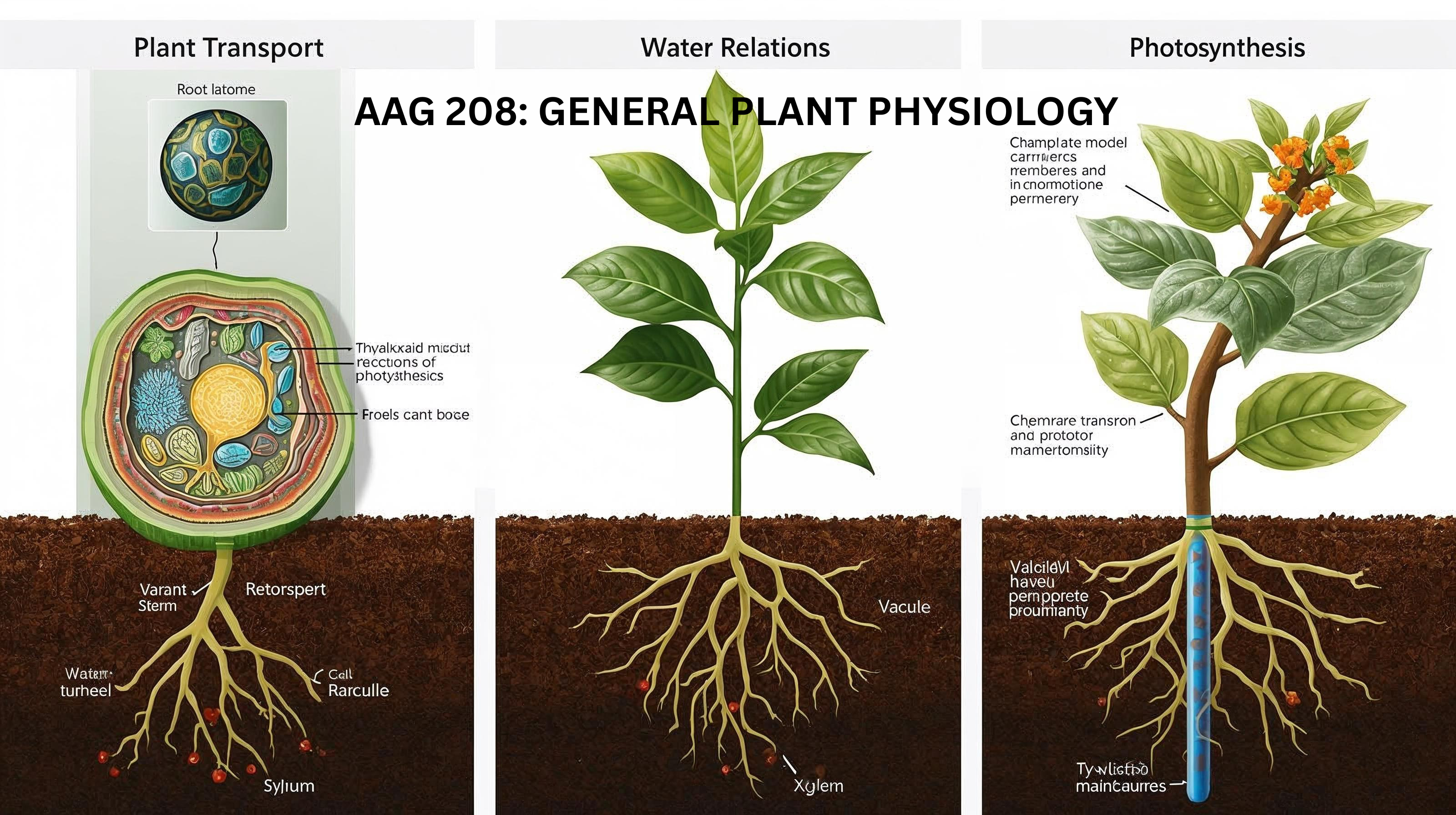
Course Overview: AAG 208 General Plant Physiology
Course Instructor: Dr. Benard O. Odhiambo
Course Description
AAG 208: General Plant Physiology offers a detailed examination of the functional and mechanistic processes that underpin plant life, from the molecular and cellular levels to the integrated whole plant and its interaction with the environment. This course explores the critical pathways of transport within plants, the physical and chemical properties governing water movement, and the sophisticated strategies plants employ to perceive, respond to, and survive a wide array of environmental stresses. A significant focus is placed on energy capture through photosynthesis, the subsequent partitioning of assimilates, and the adaptive significance of diverse photosynthetic systems. By integrating principles from cell biology, biophysics, biochemistry, and environmental science, this course provides a foundational understanding of how plants function, grow, and sustain themselves in dynamic and often challenging ecosystems. The prerequisite for this course is SBT 101.
Course Topics
The course is structured into seven major topic areas, assessed through two continuous assessment tests (CATs) that align with the following content blocks:
1. Introduction to Plant Physiology
An overview of the discipline, its scope, and its relationship to other fields such as plant morphology, ecology, and biochemistry. This section introduces the fundamental importance of water and the key physiological processes that define plant function.
2. Transport in Plants
This topic covers the mechanisms of long-distance transport:
-
Transpiration: The process of water movement through the plant and its evaporation from leaves, including the driving forces, pathways, and environmental controls such as vapor pressure deficits (VPD).
-
Phloem Transport: The translocation of photosynthetic products (assimilates) from source to sink tissues, with emphasis on the pressure-flow mechanism and the role of phloem structure.
3. Plant Cell Membrane and Its Properties and Functions
An in-depth look at the structure of cell membranes, including the fluid-mosaic model, the role of membrane proteins (integral and peripheral), and the critical concept of selective permeability. This section establishes the basis for understanding cellular compartmentalization, transport, and signaling.
4. Plant Water Relations
A foundational exploration of the physical and chemical principles governing water movement:
-
Key processes: Imbibition, diffusion, and osmosis.
-
Chemical and electrochemical potentials, including redox processes.
-
The concept of water potential (Ψ) and its components (osmotic, pressure, matrix, and gravitational potentials).
-
The hydrological balance and the properties of water that make it essential for plant life.
5. Soil-Plant-Atmosphere Continuum (SPAC)
This topic integrates the soil, plant, and atmosphere as a dynamic, continuous system for water flow:
-
Crop Water Balance: The interplay between water absorption by roots, transport through the plant, and transpirational loss.
-
Vapour Pressure Deficits (VPD): Calculation, significance, and its direct correlation with transpiration rates.
-
Water potential gradients within the SPAC and the factors controlling water movement from soil to atmosphere.
6. Plant Stress Physiology
An examination of how environmental factors disrupt homeostasis and the mechanisms plants use to cope:
-
Causes of Stress: Biotic (e.g., insects, pathogens) and abiotic (e.g., water deficit, salinity, temperature extremes, anaerobiosis, mineral deficiency/toxicity, wind, gaseous pollutants).
-
Plant Responses to Stress: Concepts of avoidance, tolerance, resistance, and acclimation.
-
Mechanisms Against Plant Stress: Adaptations such as osmotic adjustment, chelation of toxic ions, leaf modifications, stomatal regulation, cold acclimation, and the production of heat shock proteins.
7. Photosynthetic Systems, Assimilate Transport, and Partitioning
A detailed exploration of energy capture and resource allocation:
-
Photosynthetic Systems: The C3, C4, and Crassulacean Acid Metabolism (CAM) pathways, including their mechanisms, advantages, and limitations.
-
Photorespiration: The process, its consequences for photosynthetic efficiency, and its potential adaptive significance.
-
Adaptive Importance of Photosynthetic Systems: The ecological niche differentiation and geographic distribution of C3, C4, and CAM plants.
-
Assimilate Transport and Partitioning: Factors controlling the translocation and distribution of photosynthates, including sink strength, source-sink dynamics, long-distance signals, and the role of plasmodesmata.
Course Assessment
Student performance in this course is evaluated through a combination of continuous assessment and a final examination. The breakdown of assessment components is as follows:
-
Continuous Assessment Tests (CATs): Two CATs are administered during the semester, contributing twenty percent (20%) of the final grade. These tests cover the topics outlined in the course schedule and are designed to assess comprehension of fundamental concepts as well as the ability to integrate information from lectures and practical sessions.
-
Practical Sessions: Several practical sessions contribute ten percent (10%) to the final grade. These hands-on sessions reinforce theoretical concepts through demonstrations and studies of the following:
-
Demonstration of imbibition
-
Studies of osmosis in plants
-
Study of plasmolysis
-
Study of transpiration in leaves
-
Study of photosynthesis
-
-
End of Semester Examination: The final examination constitutes seventy percent (70%) of the total marks. This comprehensive examination covers all topics presented throughout the course and evaluates the student's overall understanding of plant physiology principles, their ability to synthesize information across different topic areas, and their capacity to apply knowledge to novel scenarios.
Recommended References
The following textbooks and resources are recommended to support student learning throughout the course:
-
Stephan Clemens, 2020. Plant Physiology and Function. (A contemporary resource providing detailed coverage of core physiological processes).
-
Taylor D.J., Green, N.P. and Stout, G.W. 1998. Biology Sciences. (A comprehensive general biology text offering foundational context for plant physiological concepts).
-
Salisbury, F.B. and Ross C.W, 1992. Plant Physiology, 4th Edition. Wadsworth. (A classic, in-depth textbook that provides comprehensive explanations of plant physiology principles).
-
Hay, R. and Porter, J. 2006. The Physiology of Crop Yield, 2nd Edition. Blackwell Publishing Limited. (A valuable resource focused on the application of physiological principles to agricultural systems and crop production).
- Teacher: Dr. Benard Odhiambo
