

AAG 203: PLANT BIOCHEMISTRY - COURSE OVERVIEW
COURSE LECTURER: DR. BENARD ODHIAMBO
1. Course Description
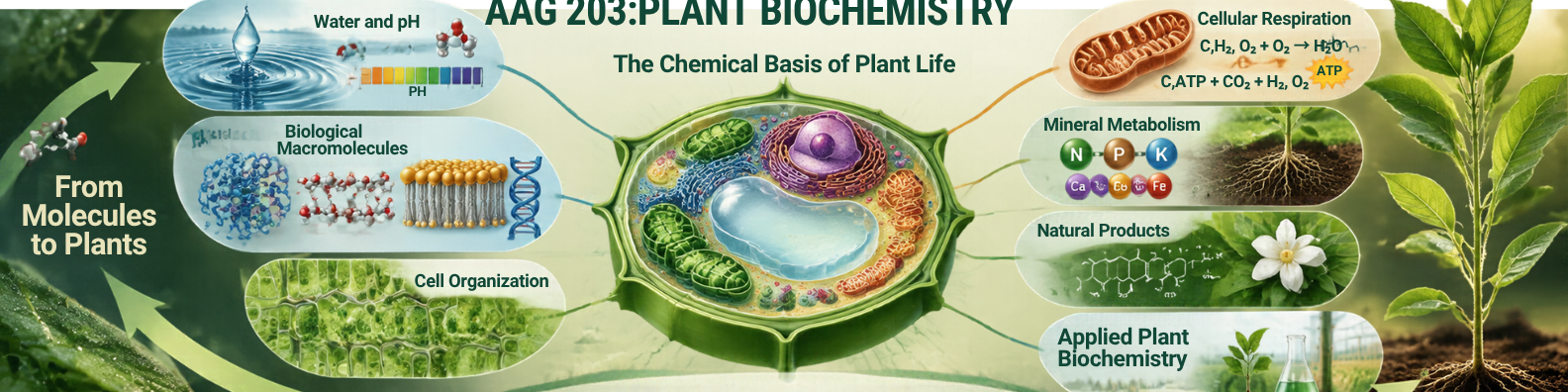
AAG 203: Plant Biochemistry is a foundational course that examines the chemical basis of plant life. It explores the structure, function and metabolism of the molecules that make up plants, the chemical reactions that sustain plant growth and development, and the ways in which plants capture, store and utilise energy. The course also considers the applied importance of plant biochemistry in agriculture, food security, biotechnology, industry and medicine.
Because plants are autotrophic - able to build their own organic matter from inorganic precursors using light energy - they synthesise an enormous range of molecules, many of which are unique to the plant kingdom. Plant biochemistry therefore encompasses most of general biochemistry while extending into areas of chemistry found only in plants. The course is designed to give learners a solid grounding in the molecular mechanisms of plant life and their practical applications.
2. Course Aim
The aim of this course is to:
- Introduce learners to the fundamental principles of plant biochemistry.
- Provide a detailed understanding of the chemistry of water, acids, bases and buffers.
- Describe the structure and function of the four classes of biological macromolecules.
- Explain the organisation of the plant cell and its organelles.
- Describe cellular respiration and energy metabolism in plants.
- Examine mineral metabolism, especially nitrogen, sulfur and phosphorus assimilation.
- Introduce the diversity, ecological roles and applied importance of plant natural products.
3. Course Learning Outcomes
By the end of this course, learners should be able to:
- Define plant biochemistry and related terminologies, and explain the scope of the discipline.
- Explain the properties of water and the chemistry of acids, bases and buffers, including the Henderson–Hasselbalch equation and ampholytes.
- Describe the structure, function and biological roles of carbohydrates, lipids, proteins and nucleic acids.
- Outline the organisation of the plant cell and the functions of its organelles.
- Describe the processes of glycolysis, the Krebs cycle, oxidative phosphorylation and anaerobic respiration, and explain how respiration is regulated.
- Explain nitrogen metabolism - nitrogen fixation, nitrate assimilation, amino acid synthesis, and sulfur and phosphorus assimilation.
- Classify plant natural products (terpenoids, phenolics, alkaloids and nitrogen-containing compounds) and explain their ecological and applied importance.
- Apply biochemical knowledge to practical problems in agriculture, food security, biotechnology, industry and medicine.
4. Course Content Outline
The course is organised into seven topics:
Topic 1: Introduction to Plant Biochemistry
- Definition of biochemistry and plant biochemistry
- Scope of plant biochemistry
- Plant biochemistry as a basic and applied science
- Integration with physiology, cell biology, molecular biology and other plant sciences
- Source–sink relationships
- Plant structure and environmental challenges
Topic 2: pH and Buffers
- Properties of water
- pH, acids and bases
- Weak acids and pKa
- The Henderson–Hasselbalch equation
- Titration curves
- Buffers and buffering range
- Ampholytes and the isoelectric point
Topic 3: Biological Macromolecules
- Introduction to the four classes of macromolecules
- Carbohydrates: monosaccharides, disaccharides, polysaccharides; α- and β-glucose; starch and cellulose
- Lipids: fats, phospholipids and steroids; saturated, unsaturated and trans fats
- Proteins: amino acids, peptide bonds, protein structure levels and classification
- Nucleic acids: nucleotide structure, purines and pyrimidines, DNA and RNA, complementary base pairing
Topic 4: Cell and Its Organisation
- The plant cell: definition and general structure
- Cell wall: composition and thickening patterns
- Protoplast: cytoplasm, nucleus and plastids
- Cytoplasmic organelles: mitochondria, Golgi bodies, endoplasmic reticulum, ribosomes, lysosomes, vacuoles and centrosome
- Cell inclusions (ergastic substances): reserve materials, secretory products and waste products
- The nucleus: structure and functions
Topic 5: Cellular Respiration
- Introduction to respiration
- Aerobic respiration: glycolysis, link reaction, Krebs cycle
- Anaerobic respiration
- Oxidative phosphorylation: electron transport chain and chemiosmosis
- ATP yield
- Conditions affecting respiration
- Comparison of photosynthesis and respiration
- Regulation of cellular respiration
- Cyanide-resistant respiration (alternate oxidase pathway)
Topic 6: Mineral Metabolism
- Introduction to mineral metabolism
- Molecular nitrogen and the nitrogen cycle
- Nitrogen fixation: abiological and biological
- Free-living and symbiotic nitrogen-fixing organisms
- Mechanism of biological nitrogen fixation and the enzyme nitrogenase
- Root nodules and leghemoglobin
- Ammonification, nitrification and denitrification
- Nitrate and ammonia assimilation
- Amino acid synthesis: reductive amination, transamination and amide formation
- Sulfur assimilation
- Phosphorus assimilation
Topic 7: Other Natural Products
- Primary versus secondary metabolites
- Terpenoids: classification, biosynthesis and functions
- Phenolics: phenylpropanoids, flavonoids, stilbenoids and tannins
- Alkaloids: biosynthesis, classification and applications
- Nitrogen-containing compounds: non-protein amino acids, cyanogenic glycosides, glucosinolates, lectins and peptides
- Other natural products: polyketides, polyacetylenes and polyenes
- Sites of synthesis and storage
- Ecological roles of secondary metabolites
- Applied importance in pharmaceuticals, food, agriculture and industry
5. Mode of Delivery
The course is delivered through a blend of:
- Reading assignments - PDF notes, prescribed textbook chapters and other literature.
- Self-study - guided reading, note-making and self-check questions.
- Learning activities - quizzes, discussion forums and assessment tasks.
- Practical examples - case studies linking plant biochemistry to agriculture, industry and medicine.
6. Required Readings
- Buchanan BB, Gruissem W and Jones RL (2000). Biochemistry and Molecular Biology of Plants. IK International Private Ltd., New Delhi.
- Held HW (2005). Plant Biochemistry, 3rd edition. Elsevier Inc.
- Hopkins WG and Hunter NPA (2004). Introduction to Plant Physiology, 3rd edition. John Wiley and Sons.
- Verma SK (2006). A Textbook of Plant Physiology and Biochemistry, 5th edition. S. Chand & Co. Ltd.
Additional readings and PDF topic notes are provided in the course portal.
7. Assessment
Assessment is based on:
- Self-check questions and quizzes at the end of each topic.
- Discussion forum participation (e.g., the Topic 1 discussion on the scope of plant biochemistry, worth 6 marks for the best-voted presentation).
- Continuous assessment - assignments and practical exercises.
- Final examination - covering all seven topics.
8. Hardware/Software Requirements
Learners require:
- A computer with internet access
- CD-ROM (where applicable)
- Reading books and a course manual
- Access to the course portal for quizzes, discussion forums and reading materials
9. Course Expectations
Learners are expected to:
- Read the topic notes and prescribed readings before attempting assessments.
- Complete all self-check questions and quizzes.
- Participate actively in discussion forums.
- Relate biochemical concepts to real-world plant processes and applications.
- Submit assessments on time.
10. Relevance and Applications
Plant biochemistry underpins:
- Food security - improving photosynthetic efficiency, nutrient use efficiency and stress tolerance in crops.
- Crop protection - understanding natural defence chemistry and developing environmentally compatible herbicides.
- Crop breeding - using biochemical markers and metabolite profiling to select high-yielding, nutritious varieties.
- Industrial raw materials - plant-derived fats, oils, starch, fibres and polymers as renewable feedstocks.
- Pharmaceuticals - plant secondary metabolites as drugs and drug leads; engineering plants as production platforms.
- Sustainability - gene technology to develop plants producing sustainable raw materials, reducing reliance on petrochemicals.
This course therefore provides a strong foundation for further studies in plant physiology, molecular biology, biotechnology, agronomy and natural product chemistry, and prepares learners to contribute to solving real-world problems in agriculture, industry and medicine.
- Teacher: Dr. Benard Odhiambo