

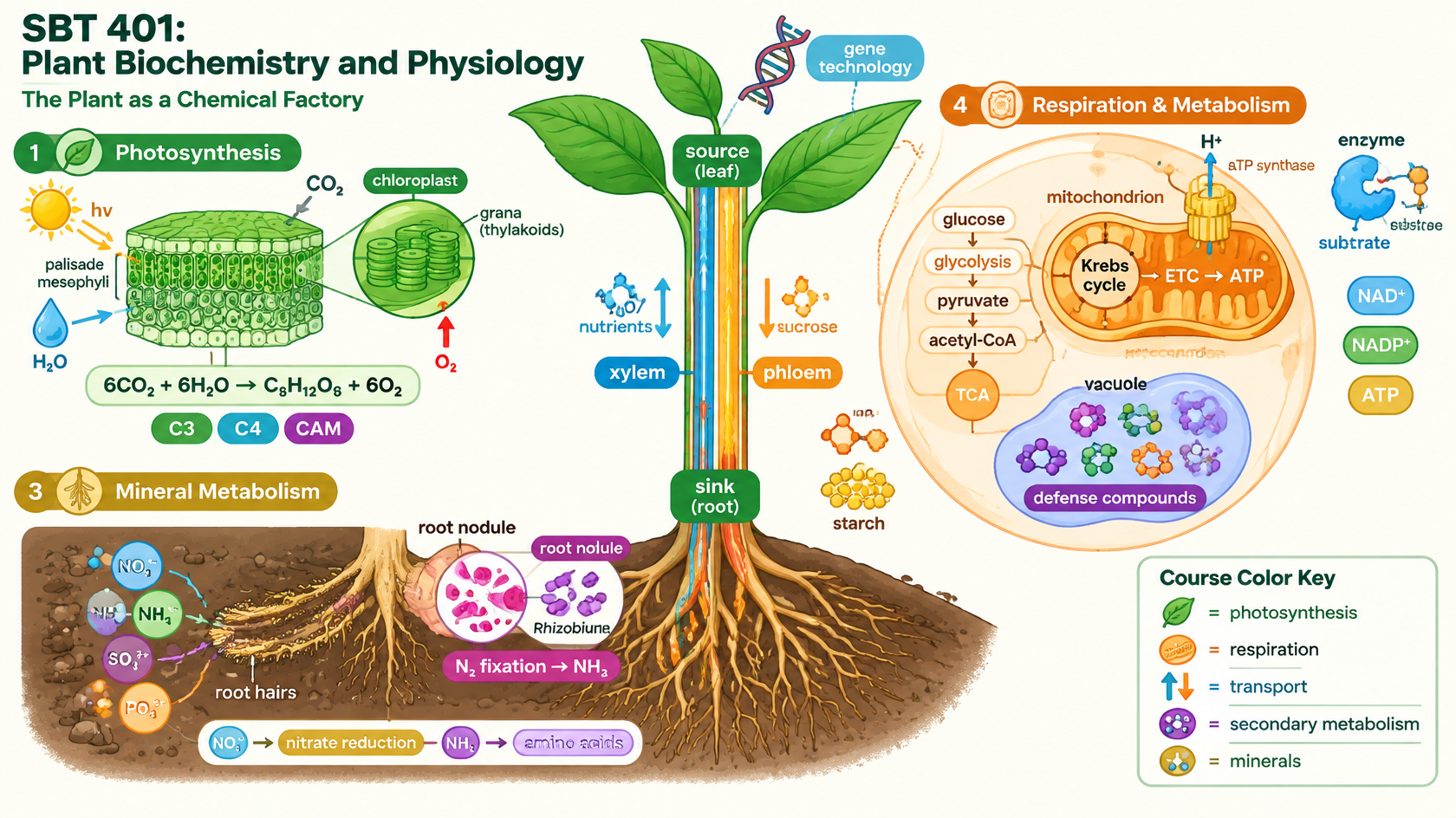
SBT 401: Plant Biochemistry and Physiology - Course Summary
Institution: Tom Mboya University | Level: Year 4, Semester 1 | Total Hours: 42 | Pass Mark: 40%
Instructor: Dr. Benard Odhiambo (bodhiamo@tmu.ac.ke)
Course Overview
Plant Biochemistry and Physiology examine the chemical basis of plant life - the nature, behavior, and transformations of the chemical constituents of living matter, and the energy changes associated with these transformations. Because plants synthesize most molecules known in nature, plant biochemistry encompasses much of general biochemistry, with emphasis on photosynthesis, plant-specific molecules, and applied areas such as crop improvement and gene technology.
Course Objectives - by the end, students should be able to:
- Discuss the biosynthesis and biodegradation of proteins, carbohydrates, and lipids in plants.
- Discuss the formation and classification of plant secondary metabolites.
Topic-by-Topic Summary
Topic 1: Introduction to Plant Biochemistry and Physiology
Ø Biochemistry = study of the chemical basis of life; plant biochemistry covers photosynthesis, synthesis of plant-unique molecules, and molecular mechanisms of plant life.
Ø Source–sink concept: leaves ("source") produce carbohydrates/amino acids via photosynthesis; roots, seeds, and storage organs ("sink") receive them via the vascular system.
Ø Plants face environmental extremes (drought, heat, frost, excess light) with flexible metabolism and cannot flee predators — hence defensive secondary compounds.
Ø Applied relevance: food security through gene technology, herbicide/virus/fungal resistance, industrial raw materials, and pharmaceuticals.
Ø Requires integration of bioenergetics, intermediary metabolism, secondary compounds, molecular biology, physiology, and cell biology.
Topic 2: Photosynthesis
Ø Definition: light energy → sugar + O₂ from CO₂ + H₂O (6CO₂ + 6H₂O → C₆H₁₂O₆ + 6O₂).
Ø Importance: supplies chemical energy and carbon skeletons; ~50% of organic material fuels plant respiration; sucrose transports to non-photosynthetic cells; global source of atmospheric O₂.
Ø Plastids: chloroplasts (photosynthesis), chromoplasts (carotenoid pigments), etioplasts (dark-grown leaves), leucoplasts (storage: amyloplasts/starch, elaioplasts/oil, proteinoplasts/protein).
Ø Pigments: chlorophylls (a and b absorb blue/red, reflect green; Mg-centered porphyrin ring with phytol tail), carotenoids (accessory pigments, photoprotection), phycobilins (water-soluble, in cyanobacteria/red algae).
Ø Photosynthetic unit: antenna chlorophylls funnel energy to a single reaction center.
Ø Light reactions (thylakoid membrane): PSII (P680) splits water → O₂, electrons flow via plastoquinone → cytochrome complex → plastocyanin → PSI (P700) → ferredoxin → NADP⁺ reductase → NADPH; proton gradient drives ATP synthase (photophosphorylation/chemiosmosis).
Ø Dark reactions (Calvin cycle, stroma): fixation (Rubisco attaches CO₂ to RuBP → 3-PGA), reduction (→ GAP), regeneration (RuBP). 3 turns → 1 GAP; 6 turns → glucose. Rubisco is the most abundant protein on Earth.
Ø Photorespiration: when stomata close and CO₂ drops, Rubisco binds O₂ → 3-PGA + 2-phosphoglycolate (wasteful; consumes ATP, releases CO₂).
Ø C3 plants (~95%): CO₂ fixed into a 3-carbon compound; stomata open by day; most efficient in cool, moist conditions.
Ø C4 plants (corn, sugarcane, sorghum): Kranz anatomy (bundle sheath + mesophyll); PEP carboxylase fixes CO₂ into oxaloacetate → malate shuttled to bundle sheath where Calvin cycle runs; minimizes photorespiration; better water and nitrogen use efficiency.
Ø CAM plants (cacti, pineapple, agaves): temporal separation — stomata open at night, CO₂ stored as malic acid in vacuoles, released to Rubisco by day; extreme water-use efficiency; can "idle" in severe drought.
Topic 3: Cellular Respiration
Ø Definition: oxidation–reduction breakdown of organic compounds (e.g., glucose) to release energy as ATP.
Ø Aerobic respiration: C₆H₁₂O₆ + 6O₂ → 6CO₂ + 6H₂O + energy.
Ø Glycolysis (cytoplasm): glucose → glucose-6-P → fructose-6-P → fructose-1,6-BP → two 3-carbon molecules (GAP/DAP) → 1,3-BPG → 3-PGA → 2-PGA → PEP → pyruvate. Net yield: 2 ATP + 2 NADH per glucose.
Ø Pyruvate oxidation: pyruvate → acetyl-CoA + CO₂ + NADH (pyruvate dehydrogenase).
Ø Krebs/TCA cycle (mitochondrial matrix): acetyl-CoA + oxaloacetate → citrate → isocitrate → α-ketoglutarate → succinyl-CoA → succinate → fumarate → malate → oxaloacetate; yields NADH, FADH₂, GTP/ATP, and CO₂; also supplies biosynthetic precursors.
Ø Electron transport chain (inner mitochondrial membrane): Complexes I–IV pass electrons from NADH/FADH₂ to O₂ (final acceptor → H₂O); proton pumping creates a gradient.
Ø Chemiosmosis/oxidative phosphorylation: protons flow back through ATP synthase → ATP. Total yield ≈ 30–32 ATP per glucose.
Ø Anaerobic respiration/fermentation (cytoplasm): glucose → 2 ethanol + 2CO₂ + small energy; higher plants tolerate only briefly (toxic products accumulate; waterlogging injury).
Ø Cyanide-resistant (alternative) respiration — unique to plants: electrons branch at ubiquinone to an alternative oxidase (X), bypassing cytochrome oxidase; inhibited by m-CLAM; produces heat (thermogenic plants like Arum) and supports fruit ripening (climacteric) and continued TCA operation.
Ø Regulation: allosteric control and feedback inhibition — PFK (inhibited by ATP, citrate; activated by AMP), pyruvate dehydrogenase (inhibited by ATP/NADH/acetyl-CoA; activated by ADP/pyruvate), isocitrate dehydrogenase and α-ketoglutarate dehydrogenase.
Ø Conditions affecting respiration: O₂ concentration, temperature (optimum 30–35°C), light, water supply, cell vitality/age, CO₂ concentration, nutritive materials.
Topic 4: Mineral Metabolism
Ø Nitrogen fixation: conversion of atmospheric N₂ into plant-available forms; non-biological (lightning, industry) and biological (Azotobacter, Clostridium, Rhizobium, Anabaena, actinomycetes).
Ø Symbiotic fixation in legumes: Rhizobium infection → root nodules → bacteroids; nitrogenase (Fe-protein + MoFe-protein) reduces N₂ → NH₃ (needs ATP, electrons via ferredoxin, Mg²⁺); protected from O₂ by leghemoglobin.
Ø Nitrate reduction: nitrate → nitrite (nitrate reductase, cytosol) → NH₄⁺ (nitrite reductase, plastids).
Ø Ammonia assimilation: NH₄⁺ + glutamate → glutamine (GS); exported as asparagine (temperate legumes) or ureides (tropical legumes).
Ø Sulfur assimilation: sulfate uptake → APS → sulfite → sulfide (ferredoxin-dependent) → cysteine (from O-acetylserine) → methionine, glutathione; occurs mainly in chloroplasts.
Ø Phosphorus assimilation: P is the second most limiting macronutrient; taken up as phosphate (H₂PO₄⁻), most available at pH 6–7; organic (phytic acid) and inorganic soil pools; geochemical rather than biological control dominates.
Topic 5: Metabolism of Macromolecules
Ø Metabolism = all enzyme-catalyzed transformations; catabolism (energy-yielding degradation) vs. anabolism (energy-requiring biosynthesis). Four functions: obtain energy, make building blocks, assemble macromolecules, form/degrade specialized biomolecules.
Ø Carbohydrates: Calvin cycle GAP/DHAP exported to cytosol → hexose monophosphate pool (glucose-1-P, glucose-6-P, fructose-6-P). Starch synthesis in plastids via ADP-glucose (ADP-glucose pyrophosphorylase; activated by 3-PGA, inhibited by Pi); amylose + amylopectin. Starch hydrolysis during germination: gibberellic acid induces α-amylase in the aleurone layer → maltose/glucose to the embryo. Sucrose synthesis in cytosol: UDP-glucose + fructose-6-P → sucrose-6-P → sucrose; sucrose is the preferred transport sugar.
Ø Lipids: fatty acid synthesis in plastid stroma; committed step = acetyl-CoA → malonyl-CoA (acetyl-CoA carboxylase); requires six enzymes (vs. one multifunctional protein in other eukaryotes). TAG storage lipids synthesized via the Kennedy pathway in the ER; stored in oil bodies (oleosin-coated monolayers).
Ø Amino acids: nitrogen/sulfur sources from assimilation; carbon skeletons from Calvin cycle intermediates (3-PGA → PEP → pyruvate/shikimate). Five families: glutamate (α-KG), pyruvate, aspartate, shikimate (PEP + E4P), serine (3-PGA); histidine from ribose-5-P. The shikimate pathway (PEP + E4P → chorismate) yields aromatic amino acids and precursors of lignin, flavonoids, and other phenolics.
Topic 6: Plant Secondary Metabolism
Ø Secondary metabolites — no direct role in growth/development; restricted taxonomic distribution; ecological functions (herbivore/microbe defense, allelopathy). Four groups: terpenoids, alkaloids, phenolics, glycosides.
Ø Terpenoids (~25,000): polymers of isoprene (C₅H₁₀) units built from IPP/DMAPP; two routes — mevalonic acid pathway (cytosol) and DOXP/MEP pathway (plastids). GPP (C₁₀) → monoterpenes; FPP (C₁₅) → sesqui-/triterpenes (squalene); GGPP (C₂₀) → di-/tetraterpenes (carotenoids). Classes: hemi-, mono- (menthol, pyrethrins), sesqui- (artemisinin, azadirachtin), di- (gibberellins, phytol), tri- (phytosterols, saponins), poly-/tetra- (carotenes, xanthophylls, rubber). Functions: hormones (ABA, gibberellins), pigments, defense toxins.
Ø Phenolics (~8,000): aromatic rings with hydroxyl groups; from shikimate/phenylpropanoid pathways (phenylalanine → cinnamic acid → hydroxycinnamate). Includes coumarins (antimicrobial, e.g., aflatoxin relatives), flavonoids (anthocyanidins — red/purple/blue pigments; flavones/flavonols — UV protection; isoflavones — phytoalexins), tannins (protein-binding, astringent, anti-herbivory; hydrolysable vs. condensed), and lignin (mechanical support).
Ø Alkaloids (~12,000): basic, N-heterocycle-containing compounds from amino acids; defense compounds (nicotine, caffeine, senecionine). Classified by ring system: pyrrolidine, piperidine, pyridine (nicotine), quinoline (quinine), isoquinoline (morphine), indole (reserpine), purine (caffeine). Biosynthetic examples: Trp → tryptamine → strictosidine → ajmaline/vinblastine; tyrosine → norcoclaurine → S-reticuline → berberine or morphine.
Topic 7: Enzymes, Coenzymes and Vitamins
Ø Enzymes = macromolecular biological catalysts (mostly proteins, some catalytic RNA); lower activation energy, are not consumed, do not alter equilibrium, and are highly specific.
Ø Structure: globular proteins; the active site (catalytic + binding sites) occupies only ~2–4 residues; allosteric sites regulate activity; denaturation abolishes activity.
Ø Cofactors: non-protein helpers — inorganic (metal ions, Fe–S clusters) or organic. Organic cofactors are either coenzymes (loosely bound, e.g., NAD⁺/NADP⁺, ATP, coenzyme A, folic acid, SAM) or prosthetic groups (tightly/covalently bound, e.g., biotin, heme). Apoenzyme + cofactor = holoenzyme.
Ø Coenzymes carry chemical groups (hydride, phosphate, acetyl, methyl, formyl) between enzymes and are continuously regenerated.
Ø Biological functions: signal transduction (kinases/phosphatases), movement (myosin ATPase), active transport (ion pumps), digestion (amylases, proteases, cellulase in ruminants), bioluminescence (luciferase), viral enzymes.
Ø Enzymes determine which metabolic steps occur and how pathways are regulated.
Assessment & Grading
|
Component |
Weight |
|
Discussion forum participation, homework, CATs |
15% (CAT) + forum/assignments |
|
Laboratory practical |
15% |
|
Final examination |
70% |
|
Total |
100% |
Grading: A = 70–100% | B = 60–69% | C = 50–59% | D = 40–49% | Fail = ≤39%
Requirements: Pass mark 40%; all assignments submitted; forum participation mandatory; fees cleared before exams.
Delivery & Expectations
- Blended format: face-to-face + online (course website, discussion forums, auto-graded quizzes, uploaded assignments).
- Students need a computer/smartphone with internet and a digital camera for capturing and sharing real-life situations.
- Core texts: Buchanan, Gruissem & Jones (2000); Heldt (2010, 3rd ed.); Bowsher, Steer & Tobin (2008); Taiz & Zeiger (2006/2014); Hopkins & Hunter (2004); Verma (2006).
Key Integrative Themes
- Energy flow: photosynthesis captures light → respiration converts stored energy into ATP → both use chemiosmosis.
- Carbon and nitrogen economy: Calvin cycle → sugars → sucrose transport → starch/lipid/amino acid synthesis; nitrogen fixed/assimilated into amino acids.
- Regulation: allosteric feedback control (PFK, pyruvate dehydrogenase) matches pathway activity to cellular energy needs.
- Adaptation: C4/CAM photosynthesis, cyanide-resistant respiration, and secondary metabolites are evolutionary responses to environmental stress and predation.
- Applied value: crop improvement, food security, industrial raw materials, and pharmaceuticals.
- Teacher: Dr. Benard Odhiambo